
The value loop to overcome challenges and limits of traditional value chain views
In our journey to explore enterprise architect supporting unfinished products, one of the key milestone is to develop a clear view on how value is created and exchanged.
While the traditional value chain definition supports an initial ice-breaking strategy, it falls short of embracing purpose and customer-centric view.
This article starting from the value chain challenges and limits, looks at the opportunities to architect the purpose and the customer experience thanks to the value loop.
The Value chain – Michael Porter in his book “Competitive Advantage”[1] defines the value chain as the discrete and interrelated activities that a firm performs to create value for their customers.
The value chain analyzes and categories the process and capabilities enabling firm to:
- in sourcing supplies and services from vendors
- assembling and creating their product or service by core operations
- distributing the product/service to the various channels and locations
- creating awareness and the compelling story around the product/service; engaging with customer and consumers to induct the sale of the product/service to the customer
- providing additional services (e.g. support) around the product/service sold
The firm competitive advantage is built on the firms ability on differentiating itself in any (if not all) this stages. Reducing costs, creating a unique experience; increasing the quality of the product along the chain is how the firm creates value for the customers and consumers.
Those stages (represented vertically in the Michael Porter value chain view pictured below) are the primary activities. Primary activities are straighten by the support activities the firm implements like:
- its own infrastructure (e.g. plants, machines);
- the human resource and its ability to grow and retain talents;
- the technology development and the research the firm invest on to continuously improve its offering;
- the procurement process to finance the end to end process and timely acquire goods and service necessary to execute the value chain.

There are initial reflections worth doing on the value chain representation and how traditional products reflect the waterfall mindset of the chain.
The primary concern is with sale. For traditional products (or services) “sale” is actually the first moment where the value is exchanged between the producer (the firm) and the customer. This first moment happens late in the value chain adding high entrepreneurial risks and barriers.
The secondary reflection is with service. The service stage is where firms continue (e.g. thanks to maintenance, replacement, disposal offering) keep engaging with the consumer. Having the service relegated to the far end of the value chain neglects all the critical value the consumer experience brings to the picture.
Those initial observations lead to three main limitations the traditional value chain definition faces to fully support unfinished-products ambitions and needs.
- producer/product centric view – as defined, the value chain, is structured to answer the question “how to optimize the product we sell to our customers”. It neglects the customer asking on “what the purpose and the experience’s value are”
- scale of supply – as argued above, having the “sale” (the first moment where the value is exchanged between the producer and the customer) late in the value chain leads to a high entrepreneurial risks. One of the strategy firms implement to mitigate this risk is based on supply economy of scale. Reducing the procurement and production costs alleviates the risk for the firm.
- focused on optimizing the output – the value chain is all focused on the production to sale journey. Efficiency is king! Key Performance Indicators (KPIs) as throughput[2], cycle time[3], demand forecast[4], overall equipment effectiveness[5] are the critical metrics where most of the firm base their competitive advantages. We could argue purpose (an interesting way of measuring the Purpose is “Return On Purpose”[6])as well as customer experience KPIs (e.g. Net Promoter Score – NPS[7]; Customer Satisfaction – CSAT[8]) are not centric in the value chain. Buyer’s satisfaction and the ability to improve buyer performance are recognized as a way for a firm to differentiate themselves mainly in the context of controlling components[9]. Net Promoter Score is not mentioned in Michael Porter’s book.
Unfinished-products redesign the value geometry. The center of gravity shifts to the consumer experience. The value chain extends to include the customer perspective. Each link between the value chain nodes is decoupled enabling disruption and innovation.
Tweet

Embracing the customer view – in his book “Unlocking the customer value chain”[10], Thales S. Teixeira introduces the concept of Customer Value Chain to stress the customer-centric view of the value chain and defines the same as the discrete activities that customers perform in order to accomplish the consumption needs and wants.
At first reading the definition could be perceived in contraposition to Micheal Porter value chain. Our stands is the value chain definitions compensate each other creating the value loop instead of a chain.
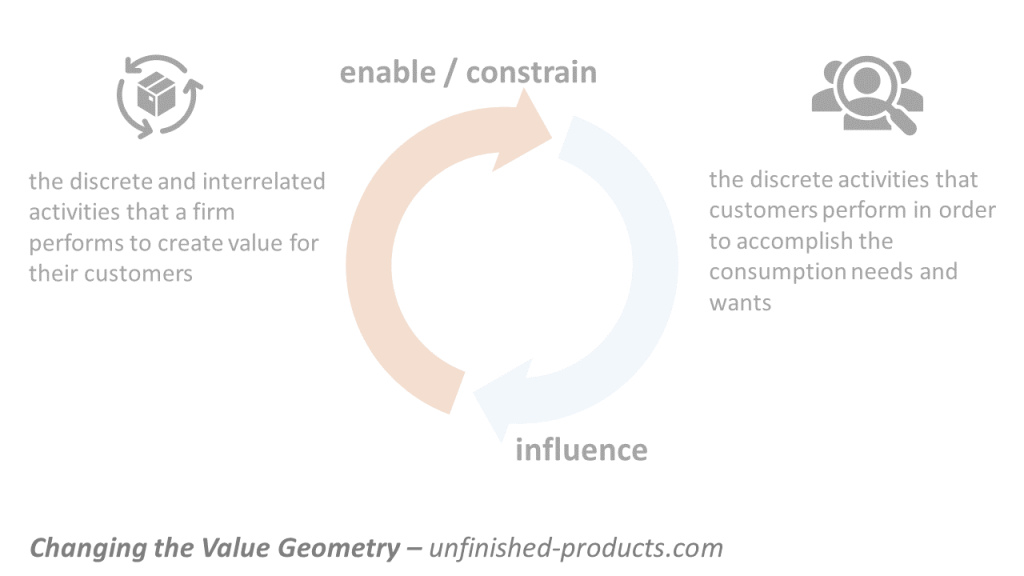
Thales S. Teixeira analyze the typical customer value chain and breaks it down to the following steps: evaluate, choose, purchase and consume.
Decoupling those four customer value chain steps creates opportunities for new business model and competitive advantage. In particular it brings back to the center the the question what the purpose and the experience’s value are.
The answer to the question must be build within all the four steps and not constrained only by currency exchange.
The discrete and interrelated activities that a firm performs to create value for their customers must map each stage of the customer value chain.
scale of demand – very often firms are fossilized in creating value only inside the organization. This has debated before, brings high investment risks to the firm itself as the time the value created is exchanged with customer (and the investment of the firm is paid back) is far in the value chain. The investment risk creates a non-inclusive economy. On one end, in terms of producers, there is a barrier to enter the market. Only entrepreneurs with plenty resources can bear and take the risk. On the other end, the risk is very often reflected in a higher product price, limiting the customer audience that decide to purchase the product.
The view point should move from who can bare the cost of creating the product (and then being in pressing needs to sale it anyhow) to the purpose we achieve on using and consuming the product [or service].
Demand-side economies of scale, formally defined when: “a good exhibits network effects if the demand for the good depends on how many other people purchase it”, are the base for platform economy (read “The Platform Economy and the importance of APIs/” story). In embracing platforms, business move from creating value inside the organization to value outside the organization. Production and consumption shift off the platform. The ability to supply value is not requested only to the producer. Platform provides to third parties and all the platform’s participants, the ability to provide value.
Demand-side economies of scale create open and inclusive economies. Platforms provide spare capacities (production, logistics, marketing, sales, evaluation, etc.) entrepreneurs can contract as service (in a pay-as-you-go model) reducing the barrier to enter a specific market and consequentially reducing the price for product and services acquired by customers. The risk mitigation is achieved by using someone else’s assets in a sustainable and satisfying way for all the ecosystem.
The competitive advantage very often translate fulfilling a purpose by selecting and matching good quality product [or service] with the right demand and customers who value it.
PURPOSE DRIVEN – producers and customers become active actors of the value loop. The unsustainable and blind production to sale one way push develops to a value creation loop where purpose and impact become central to the producers, the customers and the entire ecosystem relationship.
Output and outcome are the not the final objectives but critical interim stages on how the purpose is implemented and made sustainable.
The value loop is not closed if output and outcome do not translate in positive impact that fulfill the purpose bringing benefit to the producer, the customer and the entire ecosystem.
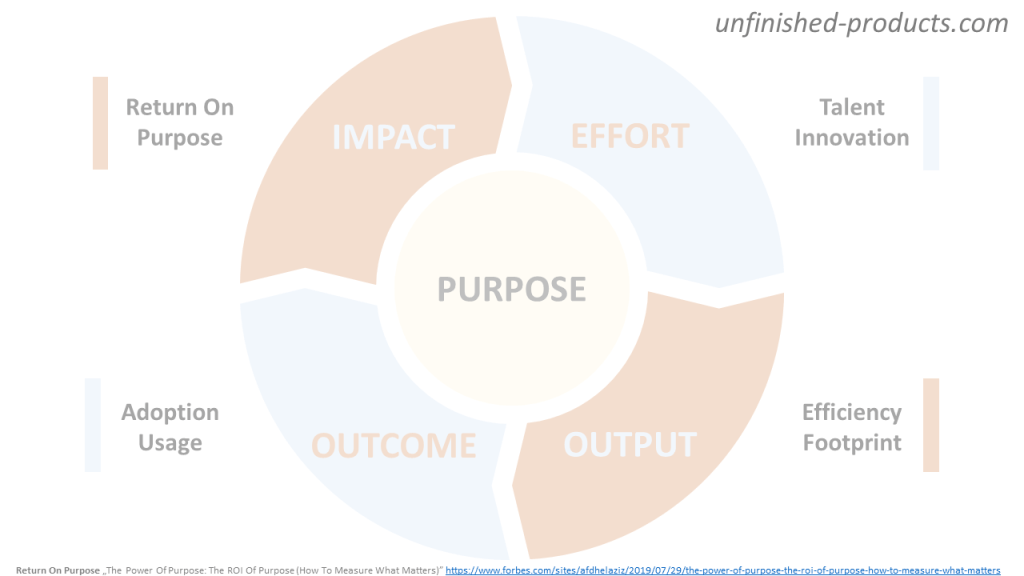
Each of the activities done by either the firm or the customer or third parties engaged in the value creation loop must be performed to fulfill the purpose.
Think of Tesla. Tesla the child poster of unfinished-products (read the “Keeping the promise” story), defined its goal as “to accelerate the advent of sustainable transport by bringing compelling mass market electric cars to market as soon as possible”[11]. The goal clearly defines the purpose: it is not about selling a given number of compelling mass market electric cars (the output) but it is all about accelerating the advent of sustainable transport.
The purpose becomes the architecture creating the harmonic interactions between the effort, the output, the outcome, and the impact.
This critical architectural concept is brought to live nattily to me in an interview published in the “Reinventing the product”[12]. The trained software engineer who worked at Tesla and interviewed by the authors of the book while talking about Tesla’s culture and how it is reflected in the organization.
In Tesla she says, there are three engineering components of equal importance and need the maximum dedication. The three components together deliver the final product.

the value loop – Interpreting Tesla purpose through the lens of the value loop defines an initial alternative framework to the traditional value chain definition for unfinished-products. The ambition is to test the value loop on other unfinished-products and to derive maturity models and playbooks to help organization to implement and deliver unfinished-products supporting their purpose and customers needs.
[1] “Competitive Advantage: Creating and Sustaining Superior Performance” Michael E. Porter – FREE PRESS – https://www.amazon.co.uk/gp/product/B003YCQ2O4
[2] The Throughput KPI measures the production capabilities of a machine, line, or plant; also known as how much they can produce over a specified time period.
Throughput = # of Units Produced / Time (hour or day) https://insightsoftware.com/blog/30-manufacturing-kpis-and-metric-examples/
[3] The cycle time metric can be used to measure the time it takes to manufacture a completed product, each individual component of the final product, or even go as far as to include delivery to the end user. Thus, cycle time can be used to analyse overall efficiency of a manufacturing process on the macro scale, as well as determine inefficiencies on a micro scale.
Cycle time = Process End Time – Process Start Time https://insightsoftware.com/blog/30-manufacturing-kpis-and-metric-examples/
[4] Demand Forecasting – This manufacturing metric is used by companies to estimate the amount of raw materials they will require to meet future customer demand. This metric can be a little bit trickier for companies to fully utilize, as it is highly dependent on uncontrollable external factors. The basic formula is as follows:
Projected Customer Demand = Raw Materials * Production Rate https://insightsoftware.com/blog/30-manufacturing-kpis-and-metric-examples/
[5] Overall equipment effectiveness (OEE) is a measure of how well a manufacturing operation is utilized (facilities, time and material) compared to its full potential, during the periods when it is scheduled to run. It identifies the percentage of manufacturing time that is truly productive. An OEE of 100% means that only good parts are produced (100% quality), at the maximum speed (100% performance), and without interruption (100% availability). https://en.wikipedia.org/wiki/Overall_equipment_effectiveness
[6] “The Power Of Purpose: The ROI Of Purpose (How To Measure What Matters)” by Afdhel Aziz – FORBES – https://www.forbes.com/sites/afdhelaziz/2019/07/29/the-power-of-purpose-the-roi-of-purpose-how-to-measure-what-matters.
[7] Net Promoter or Net Promoter Score (NPS) is the percentage of customers rating their likelihood to recommend a company, a product, or a service to a friend or colleague as 9 or 10 (“promoters”) minus the percentage rating this at 6 or below (“detractors”) on a scale from 0 to 10. Respondents who provide a score of 7 or 8 are referred to as “passives” and enter into the overall percentage calculation. The result of the calculation is expressed without the percentage sign. https://en.wikipedia.org/wiki/Net_Promoter
[8] Customer satisfaction (often abbreviated as CSAT) measures how products and services supplied by a company meet or surpass customer expectation. Customer satisfaction is defined as “the number of customers, or percentage of total customers, whose reported experience with a firm, its products, or its services (ratings) exceeds specified satisfaction goals.” https://en.wikipedia.org/wiki/Customer_satisfaction
[9] Chapter 12 – Complementary Products and Competitive Advantage. “Competitive Advantage: Creating and Sustaining Superior Performance” Michael E. Porter – FREE PRESS – https://www.amazon.co.uk/gp/product/B003YCQ2O4
[10] “Unlocking the Customer Value Chain: How Decoupling Drives Consumer Disruption” Thales S. Teixeira – CURRENCY – https://www.amazon.co.uk/Unlocking-Customer-Value-Chain-Decoupling/dp/152476308X
[11] The Mission of Tesla – Elon Musk, Chairman, Product Architect & CEO November 18, 2013 – https://www.tesla.com/blog/mission-tesla
[12] Insights from the Field – Tesla – “Reinventing the Product: How to Transform your Business and Create” Eric Schaeffer and David Sovie – KoganPage – https://www.amazon.co.uk/Reinventing-Product-Transform-Business-Digital/dp/0749484640
 Unfinished Products
Leave a comment