
Introducing the Enterprise Architecture framework for Unfinished Products Business Capabilities and testing the same on Tesla’s strategy and capabilities.
This article will provide a detailed view on the set of Business Capabilities and Functions Enterprise Architect engaged in implementing Unfinished-Products needs to model and to deliver. The goal is to provide to the Enterprise Architect a framework they can use to represent and to document their unfinished-product Enterprise Architecture view. For proving the solidity and validity of the hypothesis defined in the article, the framework will be tested against Tesla documented capabilities and strategic views.
Before formulating the hypothesis on what a valid the Enterprise Architecture framework for the logical view of the Unfinished Products Business Capabilities is, let’s recall few definitions that will help us start to identify the critical landmarks of the framework itself.
Let’s start from Enterprise Architecture. There are several definitions and interpretations on what an Enterprise Architecture is. Knowing that the end-in-mind of the Enterprise Architecture is always to support the Enterprise Business Objective, the definition from Gartner does stress the business outcome:
“Enterprise Architecture (EA) is a discipline for proactively and holistically leading enterprise responses to disruptive forces by identifying and analyzing the execution of change toward desired business vision and outcomes. EA delivers value by presenting business and IT leaders with signature-ready recommendations for adjusting policies and projects to achieve targeted business outcomes that capitalize on relevant business disruptions.”
Enterprise Architecture definition by Gartner https://www.gartner.com/en/information-technology/glossary/enterprise-architecture-ea
The Enterprise Architecture is usually developed and visualized thanks to few architecture views and detailed definition of those view’s components.
One of the more important view and surely the first view for starting to visualize the Enterprise Architecture is the view that describe the Business Domains and the Functions of the given organization (the Enterprise).
The Business Domains and Functions Architecture View articulates the business concerns that are meaningful to anyone asking herself what business capabilities the Enterprise needs to implement or is already implementing.
The following Logical View (developed at high level – named Level 0 – and in details – named Level 1) provides the structure list and relationship for the business capabilities representing business domains and functions typical of companies that produce and deliver Unfinished-Products.
Unfinished-Products Business Capabilities – Logical View (Level 0 and Level 1)
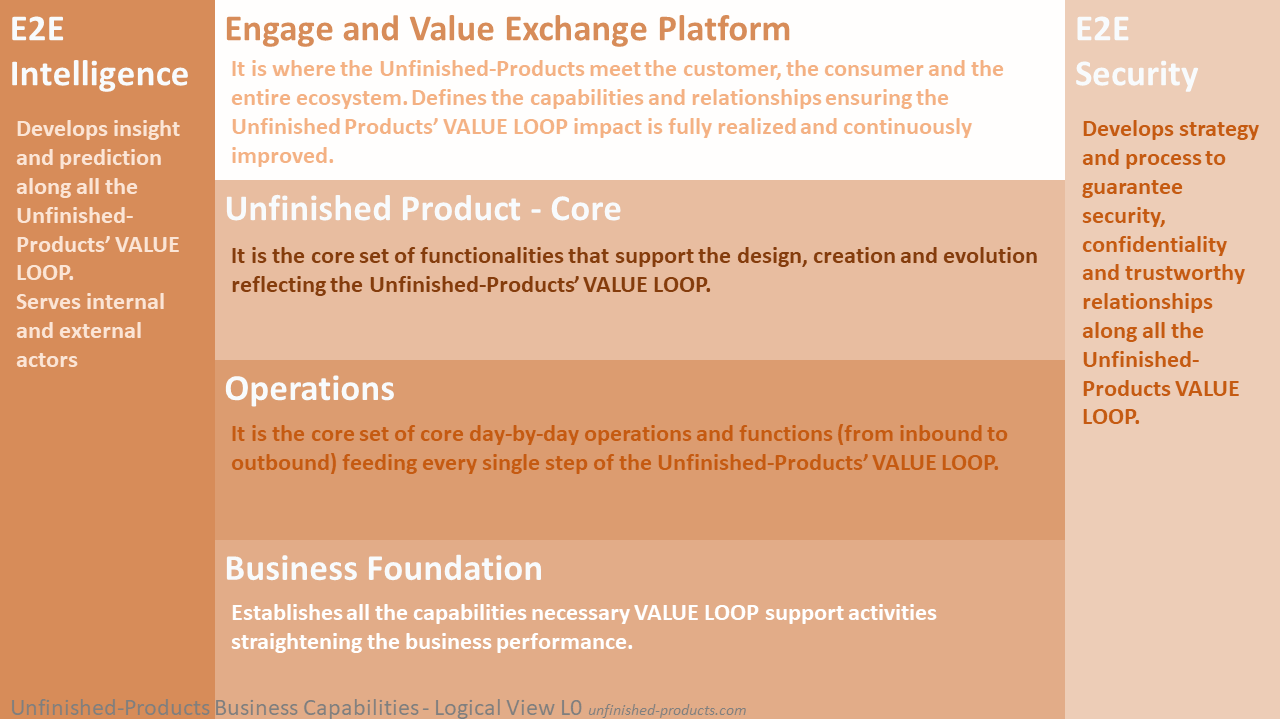

Sliding from left to right we unveil the Level 0 logical view.
The Level 0 view is an express representation of the vision for the whole system with the perspective of a very high level of related business domain set and concerns blocks.
Sliding from right to left we unveil the Level 1 logical view.
The Level 1 view articulates the Business Capability detailed view of the capacity, materials and expertise an organization embracing unfinished-products needs in order to successfully performing core functions.
Unfinished-Products Business Capabilities are built on top of the business foundation and day-by-day operations which we encounter in most of the traditional manufacturing organizations. What differs in organization producing and delivering unfinished-products is their ability to implement the unfinished-product at the core of their manufacturing processes and indeed to engage and exchange value with customer, consumers and third parties thanks to the ecosystem they participate (or own). All the Architecture is sustained by the end-to-end capabilities that implement Security and Intelligence process. Security is critical to build and maintain the trust of the all actors engaged in the ecosystem. Intelligence is core to continuously evolve and elevate the user experience and the value exchanged.
The following table provides the description of each of the high level business domains captured by the Level 0 view.
| Level 0 | Description |
| Engage and Value Exchange Platform | It is where the Unfinished-Products meet the customer, the consumer and the entire ecosystem. Defines the capabilities and relationships ensuring the Unfinished-Products’ VALUE LOOP impact is fully realized and continuously improved. |
| Unfinished Product – Core | It is the core set of functionalities that support the design, creation and evolution reflecting the Unfinished-Products’ VALUE LOOP. |
| Operations | It is the core set of core day-by-day operations and functions (from inbound to outbound) feeding every single step of the Unfinished-Products’ VALUE LOOP. |
| Business Foundation | Establishes all the support activities straightening the business performance. |
| E2E Intelligence | Develops insight and prediction along all the Unfinished-Products’ VALUE LOOP. Serves internal and external actors |
| E2E Security | Develops strategy and process to guarantee security, confidentiality and trustworthy relationships along all the Unfinished-Products life cycle. |
The following table provides the description, details and list of sample use cases of the “Unfinished Product Core” and “Engage and Value Exchange Platform” Level 1 view components.
| Level 0 | Level 1 | Level 2 – Detail | Sample Use cases |
|---|---|---|---|
| Engage and Value Exchange Platform | CONSUMER & CUSTOMER JOURNEY | This includes capabilities to design, manage and evolve the end-to-end touch points with the customer and the consumer of the unfinished-product. From the The Zero Moment of Truth (ZMOT – refers to the moment in the buying process when the consumer researches a product prior to purchase) till the time when the consumer hopefully becomes an advocate of the unfinished-product. | Persona definition and design Moment of truth (MOT) management (Zero moment of truth – defined earlier; First moment of truth – FMOT – when a customer is first confronted with the product; Second moment of truth – SMOT -: when a customer purchases a product and experiences its quality as per the promise of the brand; Third moment of truth – TMOT – consumers feedback or reaction towards a brand, product or service i.e. consumer becomes brand advocate and gives back via word of mouth or social media publishing). |
| Engage and Value Exchange Platform | INTELLIGENT SUPPORT | This includes capabilities to manage: knowledge; interaction; cases; creation & lead; age/other compliance verification; customer programs & online and offline services; survey and engagement; For what concern the unfinished-product life cycle management this includes: FOTA (firm over the air)/ software distribution; field telemetry; fleet provisioning and management; open source licenses; technical documentation; product maintenance; factory imaging; field application support | Connected Field Service enables organizations to transform the way they provide service from a costly break-fix model to a proactive and predictive service model through the combination of IoT diagnostics, scheduling, asset maintenance, and inventory on the same platform |
| Engage and Value Exchange Platform | DIGITAL MARKETING & ENGAGEMENT | Defines the priority goals of the digital marketing strategy( e.g. KPIs for each buyer stage; what channels, their effectiveness and linkage to each of the marketing strategy’ goals; campaigns to execute in helping to reach digital marketing goals) How to store and manage marketing assets in a secure, central media repository to ensure a single source of truth across the organisation. Ability to collaborate and share with ease multi-format media libraries – including videos, learning materials, logos, audio files, presentations, supporting documents, and more. | Strategic marketing Brand positioning and communication (marketing strategy execution) Brand and Communication Management Marketing resource management |
| Engage and Value Exchange Platform | ECOSYSTEM PLATFORM/S | What ecosystem (or platform) the unfinished-products should define (very rare) or to join (more likely scenario). What value to bring to the platform to which participants and how. How to govern quality and interactions | Value to exchange and participants definition Definition and monitoring of the interactions How to enter (or launching) the platform Monetization Openness management Governance and Success Metrics management Strategy and Policy definition as well as management |
| Engage and Value Exchange Platform | SALES | This includes capabilities to manage: sales forecast management; trade investment planning; joint business planning. Capabilities are implemented to manage: catalogue; price list; logistic & route; credit; order; basket checkout; reverse logistic & return. Sales Analytics are implemented in prescriptive and predictive manner to keep sales under control and to forecast | Customer care Management Commercial planning Commerce & distribution Sales force operations Management, Governance and Analysis based on : Sales data governance; sales related master data; sales data modelling; sales insight and analytics |
| Unfinished Product – Core | FEEDBACK RESEARCH & DEVELOPMENT | This includes capabilities to manage: concept ideation; concept fulfillment; component cost; ecosystem innovation & ventures; voice of customer/consumer as well as the real data on how the unfinished-product behave to day-by-day expected and unexpected usage | The Voice of the Customer and Consumer management The usage behavior telemetry analysis Ideation & development R&D portfolio management Validation as management of: submission; authorities requirements; supporting document. |
| Unfinished Product – Core | DIGITAL TWIN(*) PROTOTYPE & TEST | Prototyping and Testing moved in the digital space. Test are automated and prototypes are evaluated in digital infinitive scenarios to evaluate all the likelihood situation the unfinished-product could end up in and how it could react and behave. Digital twins allow to create, build, and test the unfinished-product a virtual environment. Thanks to digital twins the unfinished-product’s functionality are understood and its performances in response to requirements are measured well before the physical product is entirely manufactured. Digital twin can be simple (e.g. a simple 3D model) and more complex with the ability to execute manufacturing simulations as well as processing real-time data feeds from sensors that are incorporated into the physical operating environment. | Digital twin provides the opportunity to reduce prototyping and/or construction costs. That said the real value of digital twin is the ability to predict and analyze failures and unexpected behaviors in a more accurate and effective way. This give answers on how to optimize maintenance costs and downtime that can be the pain points of unfinished-products. Use cases supporting the implementation of digital twins are: effective assessment of the unfinished-product capabilities and all the quality attributes (e.g. operability, inspectability, manufacturability, sustainability) during its entire lifecycle; detection of the unfinished-product effective performance by simulating results prior manufacturing the unfinished-product itself; continuous improvement of the design of the unfinished-product. |
| Unfinished Product – Core | DIGITAL THREAD (*) | The digital thread is the communication framework enabling the integrated view and data flow during the unfinished-product entire lifecycle. Thanks to the digital threads we enable accessing, integrating & hydrating, analyzing, and transforming data from disparate systems & source the unfinished-products interact with. The insight gained from the data handled by the digital thread empower product engineers, manufacturing engineers, user experience engineers and marketers to continuously improve the unfinished-products throughout its entire lifecycle. | The digital thread helps in reducing maintenance costs by enabling predictive maintenance use cases. Digital thread data enable real-time what-if-analysis where all the stakeholders can review results and collaboratively decide how to enhance the unfinished-product. |
| Unfinished Product – Core | USER EXPERIENCE MAKE | The success of unfinished-product is in their ability to deliver a supreme user experience. It is of no surprise that the make of the user experience is a business capability of the core on its own. The user experience is not a static function and not based only on expert advice and best practice. It is dynamic and does take to account the insight offered by the digital twin as well as the voice of the customer to address their concerns and desires. | Persona definition and design – how the user experience expectations evolve A/B testing Consumer & customer journey insight and reflection on user experience User experience architecture and design User experience implementation |
| Unfinished Product – Core | INTELLIGENCE & BEHAVIOUR | Architect and Design the level of Artificial Intelligence and Machine Learning the unfinished-product will implement. How to augment the user experience, what predictive and cognitive service the unfinished-product will offer and manage. | Data Science Model implementation Cognitive service implementation |
| Unfinished Product – Core | TELECOMMUNICATION & CONNECTIVITY | Architect and Design the telecommunication and connectivity capabilities the unfinished-product will relies on. | Network MAC Stack Firmware Transfer Protocol |
| Unfinished Product – Core | OS AND SOFTWARE | Architect and Design the operating system and software capabilities the unfinished-product will implement. | Edge Gateway Container Application OS FOTA |
| Unfinished Product – Core | HARDWARE/SILICON | Architect and Design the hardware capabilities the unfinished-product will relies on. | Sensor implemented Processor Power supply Enclosure |
| Unfinished Product – Core | PHYSICAL PRODUCT DESIGN | Architect and Design the physical implementation of the unfinished-product. | Defining the product vision Product research Design Testing and validation |
Now that we defined and detailed the logical views of the Level 0 to Level 2 Business capabilities for unfinished-products, let’s see how we can interpret them in the context of the Business Capabilities implemented at Tesla and how they translate to some of the specific technology views of the Tesla offering.
Autobidder – The Tesla Virtual Power Plan
Let’s consider Tesla Autobidder. Autobidder provides independent power producers, utilities and capital partners the ability to autonomously monetize battery assets. Autobidder is a real-time trading and control platform implemented by Tesla that provides value-based asset management and portfolio optimization, enabling owners and operators to configure operational strategies that maximize revenue according to their business objectives and risk preferences. Autobidder implements the Tesla Virtual Power Plan.[2]
In the following figure we are overlapping the Autobbider Architecture as presented by Colin Breck and Percy Link during their “Tesla Virtual Power Plant” session at the Con conference in London MAR 23, 2020[3] with the Level 0 logical view for the unfinished-products’ business capabilities.
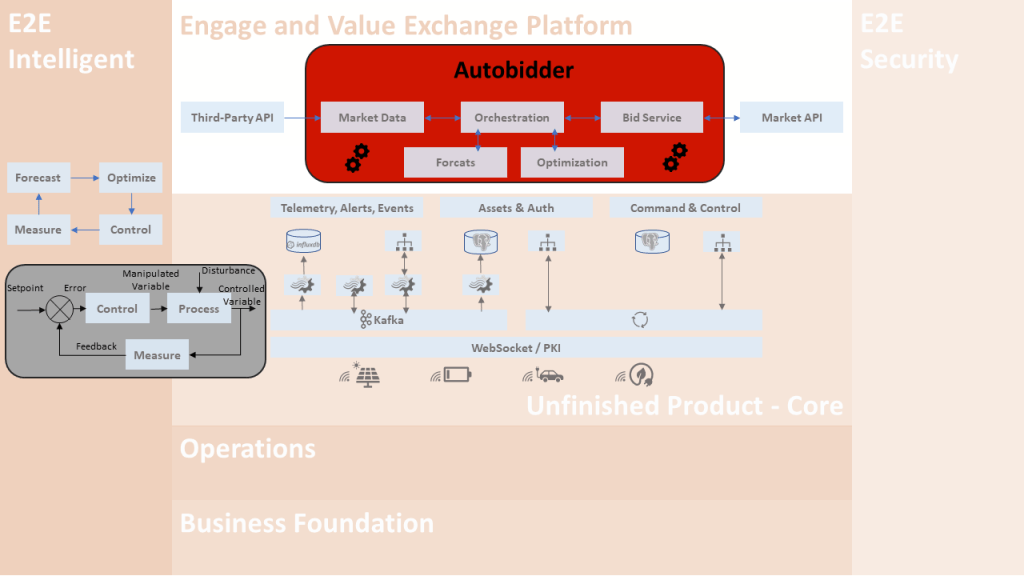
Clearly the Autobidder is where the different actors engages and exchange value. It is the platform where the optimization problem is trade-offs across different market products. Those are different kinds of services the battery can provide to the grid and trade-offs in time since the battery has a finite amount of energy.
The unfinished-product core it is the implementation of the Autobidder platform. As detailed in the conference the technology view of the Autobidder is realized by linearly scalable WebSocket front end that handles connectivity as well as security. It has a Kafka cluster behind it for ingesting large volumes of telemetry from millions of IoT devices. This provides messaging durability, decouples publishers of data from consumers of data, and it allows for sharing this telemetry across many downstream services. The platform also has a service for publish-subscribe messaging, enabling bi-directional command and control of IoT devices. These three services together are offered as a shared infrastructure throughout Tesla on which to build higher-order services.
People could question why the Autobidder implementation is central in the unfinished-product core. There could be an untold expectation that the main concern of this business capabilities is the implementation of the cars, the panels, the batteries, the charging network. Those core Tesla products are unfinished-products and indeed they will be owned and designed by the unfinished-product core business capability. That said as we will cover later in the article, the master plan and the Tesla strategy pivots around driving exponential growth from sustainable energy, thanks to Tesla Energy, Tesla Mobility and Tesla Motors. In this context the Autobidder becomes the main unfinished-products Tesla is building its strategy around.
Finally the problem Autobidder is solving is a very dynamic problem that requires continuous data analysis and prompt reaction to the changing of behavior of the actors participating to the platform as well as the external (environmental) requirements and conditions.
There is a continuous analysis of the aggregated telemetry and historical data that enable the Forecast-Optimize-Control-Measure loop. This loop it is indeed embedded in the digital twin capabilities of the unfinished-product core (the Autobidder implementation). That said we wanted to clearly highlight that this is the E2E Intelligent discipline and should require the right level of attention. The E2E Intelligent business capabilities defines processes, methodology and attitude to sustain any advanced intelligence capability. The digital twin is the dynamic implementation of the capability the E2E Intelligent defines. The digital twin translates the model/s developed by the E2E Intelligent capability in execution and implementation activities.
The Digital Twin’s Data Architecture of Tesla
Another interesting insight on how Tesla implements its car fleet digital twin (Digital Twin Instance – DTI – as per Cloudfight.io taxonomy) data architecture is provided by cloudflight.io’s article “Learnings From The Digital Twin’s Data Architecture Of Tesla”[1].
Cloudfight.io analyzes the set of API’s provided by www.teslaapi.io (a community of developers who are reverse engineering Tesla’s API) and classify them across two dimensions:
- Data Domain
- Real digital twin: implements the remote access and distribution of states as intended by accessing the digital twin concept.
- Remote access (vehicle): proxy API inquiring directly to the online vehicle without persistence on the cloud. Worth noting the majority of consumer APIs at Tesla and corresponding data sets fall into this category.
- Remote access (cloud): proxy API inquiring larger data volume stored in the cloud.
- Security Domain
- Confidential for the OEM: accessible by Tesla only.
- Accessible to the consumer: can be inquired by the authenticated consumer but they are not accessible by Tesla.
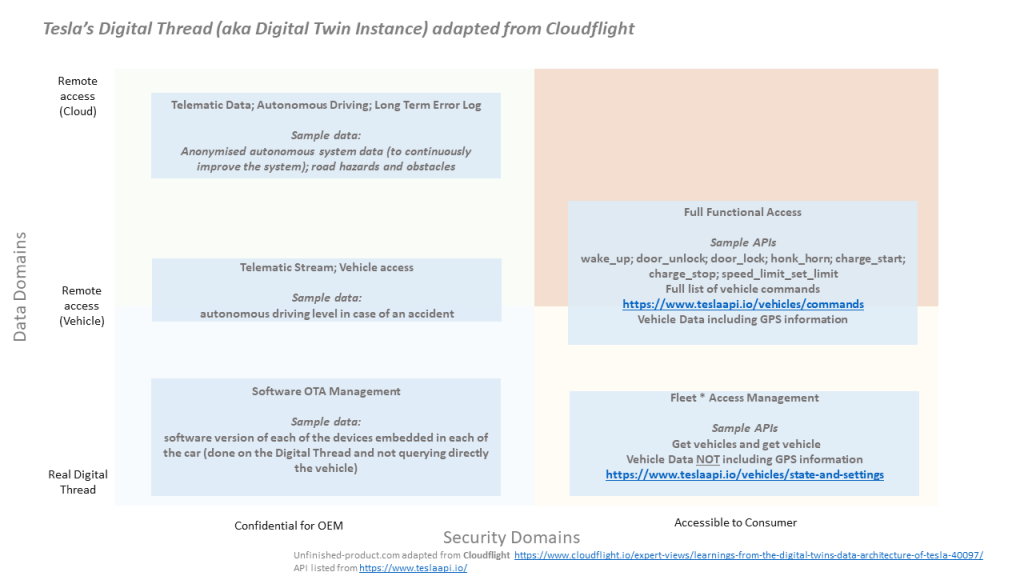
The view above gives us a valid level 3 view and insight on the Unfinished-Product – Core, Digital Twin business capability implementation at Tesla.
Tesla Strategy
Authoring two articles the Tesla’s Blog, in 2006 and 2016, Elon Musk revealed Tesla’s master plan and its long term strategy.
The master plan defined in 2006 was focused on: Build sports car; Use that money to build an affordable car; Use that money to build an even more affordable car; and while doing above, also provide zero emission electric power generation options.[4]. In 2016 it then evolved to:
Create stunning solar roofs with seamlessly integrated battery storage
Master Plan, Part Deux – https://www.tesla.com/blog/master-plan-part-deux
Expand the electric vehicle product line to address all major segments
Develop a self-driving capability that is 10X safer than manual via massive fleet learning
Enable your car to make money for you when you aren’t using it
For implementing the master plan, the business capabilities as “Engage and Value Exchange Platform”, “Unfinished-Products Core”, “E2E Intelligent” and “E2E Security” becomes paramount. The aim is to drive, thanks to Tesla Energy, Tesla Mobility and Tesla Motors, exponential growth from sustainable energy, rather than sustainable transportation only. This does reinforce the strategic role played Autobidder covered earlier in this article.
An interesting prospect on the Tesla’s strategy and master plan is covered by FROST & SULLIVAN in its article “Unbundling Elon Musk’s Tesla Masterplan For World Domination”[5]. FROST & SULLIVAN translates the core of Tesla’s masterplan in seven strategy pillars: connectivity, electrification, autonomous, battery sustainability, data business model, new mobility and organizational structuring. Those pillars define the standard pre-requisites any self-respecting automotive manufacturer should implement.
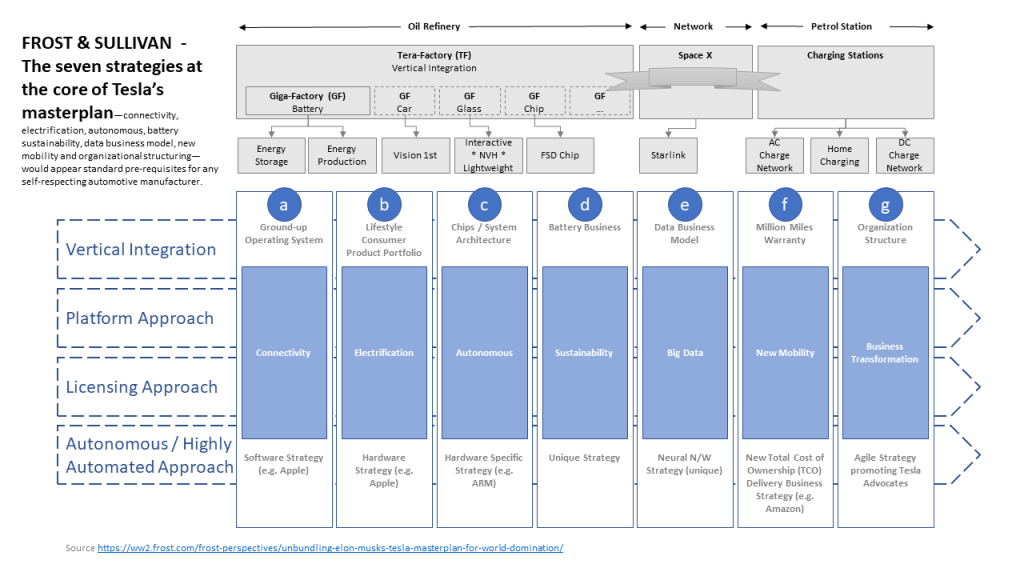
The following view and the table below provide the mapping between the FROST & SULLIVAN seven strategy pillars definition and how they relate to the unfinished-products Level 1 business capabilities we introduced in this article.
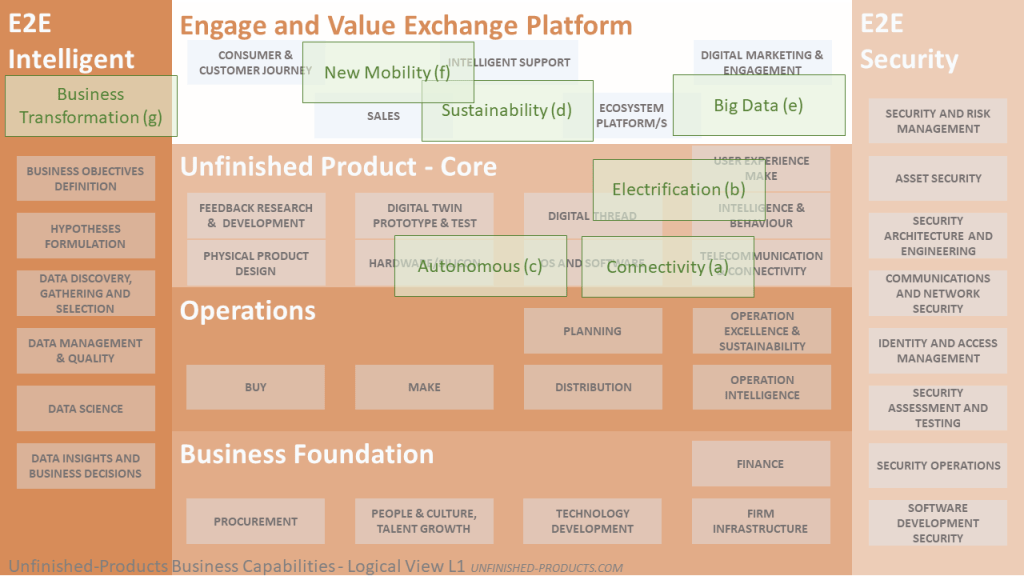
| FROST & SULLIVAN pillar | FROST & SULLIVAN pillar’ observations | Level 1 block/s mapped | Mapping details |
| Connectivity | Tesla differentiates itself with its proprietary ground OS, which enables it to be more agile, generate more innovative edge cases, distribute performance and power functionality based on new edge cases, and better protect its vehicles from cybersecurity threats because of fewer access gateways. In fact all the domains are built-up on that one single OS, reflective of a drastically different approach | “OS and Software” “Telecommunication & Connectivity” “E2E Security” | OS and Software is where the Tesla proprietary ground OS is implemented Edge cases and distribute performance are developed in the context of the “Telecommunication & Connectivity” capability. Cybersecurity and the overall security management is then owned and implemented withing the E2E Security capability. |
| Electrification | In terms of electrification, the fundamental point is Tesla vehicle is not just a car, it’s a lifestyle statement. It’s about creating a highly connected, electric car that supports superior performance and range attributes, and provides a top notch customer experience across all elements of a driver’s vehicle life onboard experience. | “User Experience Make” “Digital Thread & Twin” “Intelligence and Behavior” | “User Experience Make” is the business capability that develops the top notch customer experience. “Digital Thread & Twin” is the ability to handle, verify and simulate the superior performance and range attributes. “Intelligence and Behavior” is the implementation of the capabilities that create the Tesla’s lifestyle statement. |
| Autonomous | As the electric / autonomous driving vehicle (EV/ AD) revolution accelerates, Tesla is leading from the front in replacing horsepower with processing power. Much like Apple, Tesla’s chip has been designed in-house for a very specific use case, i.e., autonomous driving. This, along with ARM architecture, is fast-tracking Tesla’s autonomous agenda. In the process, Tesla is inventing a new currency that pivots around how much processing power can be utilized to support progressively superior energy efficiencies across core powertrain components. | “Hardware/Silicon” “Digital Thread & Twin” “Digital Twin Prototype & Test” “OS and Software” | “Hardware/Silicon” and “OS and Software” capabilities is where Tesla designs the in-house for a very specific use case chips. Once again “Digital Thread & Twin” is the ability to handle, verify and simulate the superior performance and range attributes. “Digital Twin Prototype & Test” defines and implement all the processes to continuously improving superior energy efficiencies across core powertrain components. |
| Sustainability | Battery sustainability is a crucial lynchpin in Tesla’s roadmap for the future. An update carried out earlier this year now gives third parties the ability to integrate charging stations into the Tesla map. In other words, battery pre-conditioning can now happen even if the Tesla customer chooses another charging station. | “Sales” “Intelligent Support” “Ecosystem Platform/s” | “Sales” is engaged as a new license mode is developed for the third parties to integrate their charging stations. “Intelligent Support” increase of complexity to handle the new capability of integrating third parties charging stations. “Ecosystem Platform/s” come to live with the ability for third parties the to integrate charging stations into the Tesla map. |
| Big Data | Meanwhile, Tesla is in ludicrous mode with its data business model. The business model works on the concept that any utility company or business entity (even other automakers) can use Tesla’s cutting-edge autobidder software to dispatch energy on the fly based on energy forecasting, dispatch optimization, and load forecasting. The autobidder software enables this by feeding not customer data but vehicle data in a highly anonymized way. | “Digital Marketing & Engagement” “Ecosystem Platform/s” “E2E Intelligent” | “Digital Marketing & Engagement” reaches out to the market actors and engage with them to presents the autobidder. As already analyzed in detail previously, autobidder is the definition of “Ecosystem Platform/s” at Tesla. “E2E Intelligent” supports end-to-end the definition, development and improvement of the data business model. |
| New Mobility | New mobility which represents a highly disruptive approach to total cost of ownership (TCO). The aim is to demonstrate to own a Tesla is very financially rewarding. New mobility plans includes the million miles warranty. The message and assurance is a vehicle is lasting a million miles. | “Consumer & Customer Journey” “Sales” “Intelligent Support” | “Consumer & Customer Journey” is where the TCO definition is happening and communicated. “Sales” are engaged to make the messages very clear and heard from the customers. “Intellligent Support” is where the million miles warranty challenge stands and get solved successfully. |
| Business Transformation | Tesla has embraced a flexible and distributed organizational structure. Networks of teams operate in a highly people-centred culture, with an ecosystem designed to support creativity and efficiency. | “E2E Intelligent” | The business transformation goes along all the organization and hence every single business capability. That said we wanted to call out the “E2E Intelligent” to stress the hypotheses driven approach that defines this business capability and drive the overall data and people driven culture. |
Complex System – System of Systems View
Complex organizations as Tesla is, are compose of bigger system-of-systems[6]. On his essay “Architectural innovation in the automotive industry : Tesla and the renaissance of the battery electric vehicle article” Romeu Lezama [7] documents and analyzes Tesla’s System of systems. Romeu Lezama developed the view on how Tesla, Transportation Services Providers, Technology Companies and other OEMs (original equipment manufacturer) engage and collaborate in Tesla’s System of systems composed by the vehicles Product system and Supporting system.

We reflected the Tesla’s System of systems in the business capabilities mapping. Limiting the analysis to the first level of the Tesla System of systems the mapping to the business capabilities L1 view develops as the following:
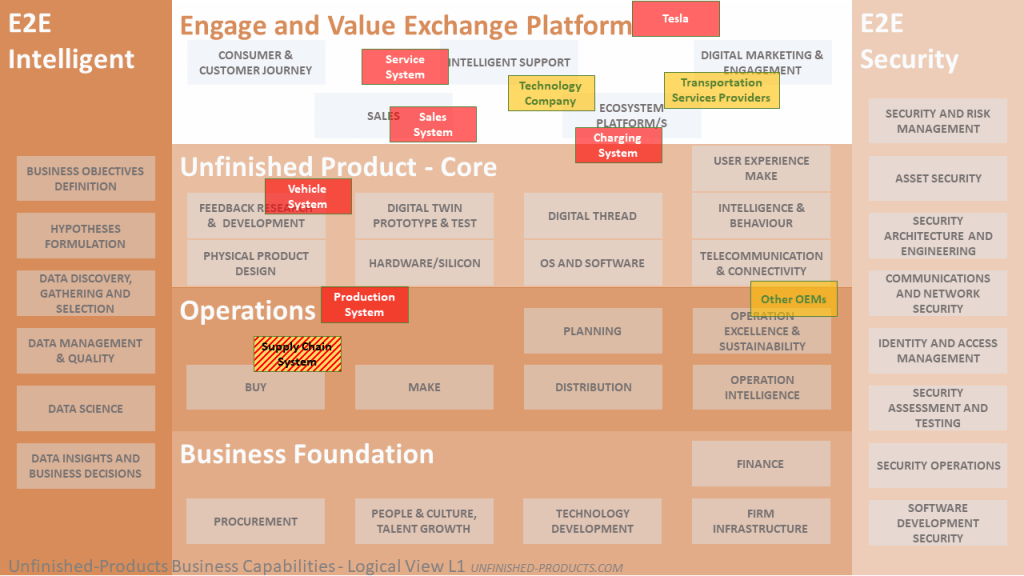
Embracing the full view of the Tesla System of systems, the mapping to the business capabilities L1 view develops as the following:

A closer look to the Sale Business Capability
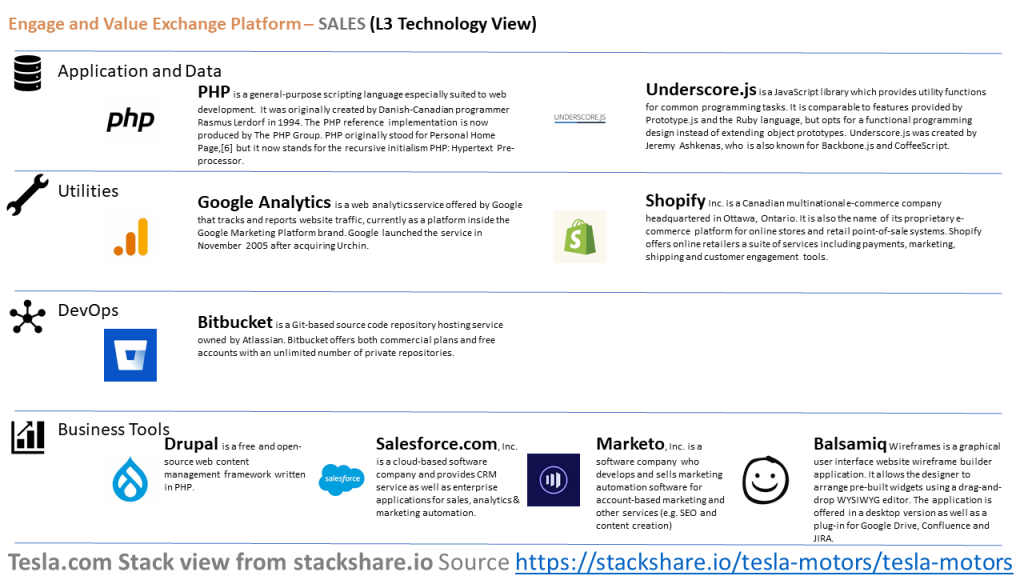
Let’s have a closer look at the sales business capability and how the capability main use cases (catalogue; price list; logistic & route; credit; order; basket checkout; reverse logistic & return) can be translated to technology capabilities implemented at Tesla.
Since 2019 Tesla took a Sale On-line Only/Mainly strategy[8] which makes Tesla online channel the most strategic pillar of its Sales business capability (worth observing Tesla in Europe is still behaving more like a traditional automaker as Tesla continues to engage with dealerships to cope with its sales expansion in the continent[9]).
Thanks to the data provided by stackshare.io[10], we can build the technology view on how Tesla.com sale capability is technically implemented. Tesla.com Technology view (Level 3) is then structured as the following schema.
A business capability that is usually peering with Sales is the Digital Marketing (or traditional Marketing) one. It is very interesting to notice that Tesla spends 0 dollars for their marketing[11].
It is understood that Tesla has very limited resources working in the marketing department, and no Chief Marketing Officer (CMO). The reason behind is that Elon Musk marketing is not a priority, production and R&D are the core priorities for the company.
The excellence of the cars (and all the other products) produced and sold are the testimonial and brand promise evidences for Tesla. Tesla marketing capabilities are built around the the following strategy to drive demand: online sales strategy, high customer satisfaction, word of mouth, and free test drives.
Tesla competitors – Hyundai and Apple rumors
Analyst are sharing rumors (and actually more than that) around a collaboration between Apple and Hyunday to accelerate the entrance of Apple in the battery electric vehicle (BEV) market. The analyst Ming-Chi Kuo shared his view on Apple Car[12] on saying Apple will work in close cooperation with Hyundai on an initial model that could lead to new vehicles built in association with General Motors and European manufacturer PSA.
The collaboration looks like to pivot around the use of the Hyunday E-GMP[13] dedicated BEV platform that consists of up to two motors, five-link rear suspension, integrated drive axle, battery cells, charging system and other rolling chassis components. According to Hyunday, the system has a maximum range of about 310 miles on a full charge and be charged up to 80% within 18 minutes. Acceleration for a “high performance” configuration is quoted at 0-60 mph in less than 3.5 seconds, with a speed ceiling of 160 mph. Hyundai intends to use E-GMP as a foundation for a variety of models set to debut under both its flagship and Kia brands this year.
“Apple’s deep collaboration with current automakers (Hyundai Group, GM, and PSA) who have extensive development, production, and qualification experience will significantly shorten the Apple Car development time and create a time-to-market advantage,” Kuo writes. “We believe that Apple will leverage current automakers’ resources and focus on self-driving hardware and software, semiconductors, battery-related technologies, form factor and internal space designs, innovative user experience, and the integration with Apple’s existing ecosystem.”
Analyst Ming-Chi Kuo https://appleinsider.com/articles/21/02/02/kuo-apple-car-to-use-hyundais-e-gmp-platform-gm-and-psa-eye-partnerships
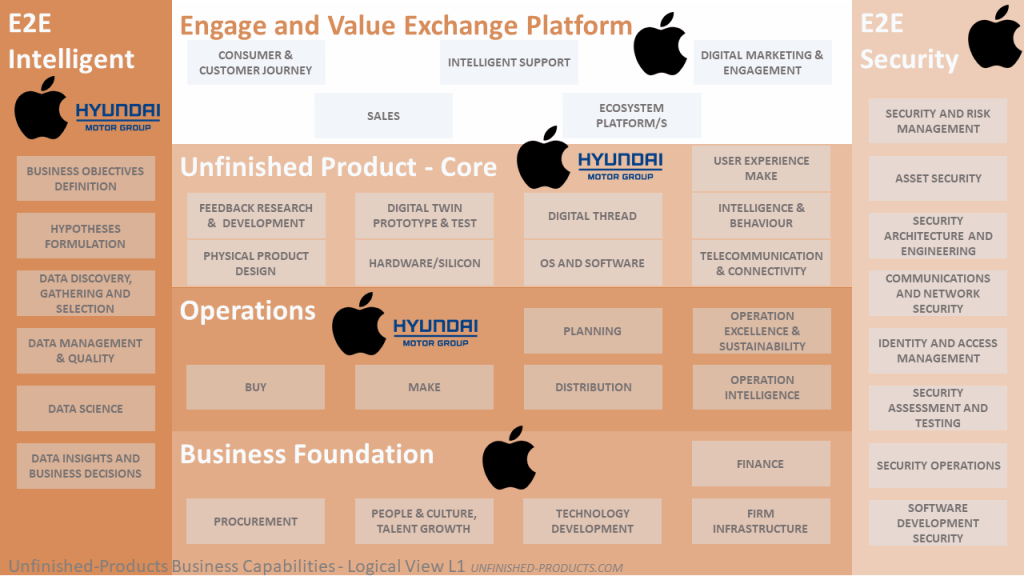
Given the analyst Ming-Chi Kuo view we exercised the Unfinished-Products Business capabilities – Logical View L0-L1 to formulate a set of hypotheses on how Apple and the Hyundai Group will define their collaboration and their overall way of working together.
The hypotheses are summarized in the following schema and detailed in the table below.
| L0 block | What Matters | Main Contributor | Value brought and differentiation |
| Engage and Value Exchange Platform | It is where the Unfinished-Products meet the customer, the consumer and the entire ecosystem. Defines the capabilities and relationships ensuring the Unfinished Products’ VALUE LOOP impact is fully realized and continuously improved. | Apple | This is definitely where Apple can bring the highest value and differentiate the product’s purpose on the market. From the intelligent support, to the digital marketing, sales, the ecosystem and indeed the user experience there is no company in the world that maximize better the engage and value exchange as Apple does. |
| Unfinished Product – Core | It is the core set of functionalities that support the design, creation and evolution reflecting the Unfinished-Products’ VALUE LOOP. | Apple and Hyundai motor group | Hyundai motor group with its own dedicated battery electric vehicle (BEV) platform the E-GMP we expect will focus on the consulting and collaborating mainly within: “FEEDBACK RESEARCH & DEVELOPMENT”; “PHYSICAL PRODUCT DESIGN”; “DIGITAL TWIN PROTOTYPE & TEST”; and the “HARDWARE/SILICON” business capabilities. Apple will own the Unfinished-Product Core business capabilities creating the end to end vision and differentiation. As the Noted TF Securities analyst Ming-Chi Kuo writes “Noted TF Securities believes that Apple will leverage current automakers’ resources and focus on self-driving hardware and software, semiconductors, battery-related technologies, form factor and internal space designs, innovative user experience, and the integration with Apple’s existing ecosystem.” |
| E2E Intelligence | Develops insight and prediction along all the Unfinished-Products’ VALUE LOOP. Serves internal and external actors | Apple and Hyundai motor group | People could argue that this should be the space for Apple only as stated above that Apple will own the Unfinished-Product Core business capabilities creating the end to end vision and differentiation. That said, for the EV the main manufacturing cost is driven by the battery costs. Hence we do see a high level degree of collaboration between Apple and Hyundai motor group engineers and analyst to define and continuously test new hypothesis that will drive the unfinished-product improvements and breakthroughs |
| E2E Security | Develops strategy and process to guarantee security, confidentiality and trustworthy relationships along all the Unfinished-Products VALUE LOOP. | Apple | Given the high co-relation with the user experience and the end-to-end unfinished-product trustworthy vision, we assume Apple to fully own the E2E Security. Surely Hyundai motor group will be consulted and informed on aspects that are related to the E-GMP. |
| Operations | It is the core set of core day-by-day operations and functions (from inbound to outbound) feeding every single step of the Unfinished-Products’ VALUE LOOP. | Apple. Hyundai motor group (special supplier) | For the operations we can see Hyundai motor group as a special supplier for Apple. Apple will lead the operations that bring together the end-to-end unfinished-product view. That said, once again given the criticality of the battery platform in the EV manufacturing process, we do see Hyundai motor group still acting as a special supplier and not completely hidden in the supply chain. |
| Business Foundation | Establishes all the capabilities necessary support activities straightening the business performance. | Apple | Unless Apple and Hyundai motor group will decide to implement a subsidiary company as “Special Purpose Vehicle”[14], we expect Apple to leverage its existing business foundation capabilities. |
Conclusions
We believe that the Unfinished Products Business capabilities – Logical View L0-L1 provides a valid framework for structuring the strategic thinking and business model for all the organization that want to implement unfinished-products.
Looking at Tesla Autobidder, Tesla strategy approach, Tesla system of systems, as well as at the implementation of Tesla digital twin instance and Tesla Sales business capability, the Unfinished Products Business capabilities framework stays soundly and solid.
The Unfinished Products Business capabilities framework gave us the opportunity to analyze how Apple and the Hyundai Group could collaborate and structure their overall way of working together. This at the light of the hypothesis formulated by the analyst Ming-Chi Kuo that Apple’s and the automakers Hyundai Group will collaborate to significantly shorten the Apple Car development time and create a time-to-market advantage.
[1] Learnings From The Digital Twin’s Data Architecture Of Tesla by Stefan Ried – https://www.cloudflight.io/expert-views/learnings-from-the-digital-twins-data-architecture-of-tesla-40097/
[2] Autobidder – https://www.tesla.com/support/autobidder
[3] Tesla’s Virtual Power Plant. Colin Breck and Percy Link explore the evolution of Tesla’s Virtual Power Plant (VPP) architecture. A VPP is a network of distributed energy-resources (often solar, wind, batteries) that are aggregated to provide smarter and more flexible power generation, distribution, and availability. Tesla’s VPP consists of vertically integrated hardware and software, including both cloud and edge computing. – www.infoq.com/presentations/tesla-vpp/
[4] The Secret Tesla Motors Master Plan (just between you and me). Elon Musk, Co-Founder & CEO of Tesla Motors August 2, 2006 – https://www.tesla.com/pl_PL/blog/secret-tesla-motors-master-plan-just-between-you-and-me
[5] Unbundling Elon Musk’s Tesla Masterplan For World Domination. Who said 2020 has been a disaster? – https://ww2.frost.com/frost-perspectives/unbundling-elon-musks-tesla-masterplan-for-world-domination/
[6] System of systems. From Wikipedia, the free encyclopedia –https://en.wikipedia.org/wiki/System_of_systems
[7] Romeu Lezama, “Architectural innovation in the automotive industry : Tesla and the renaissance of the battery electric vehicle article” – https://dspace.mit.edu/handle/1721.1/107365
[8] The Wall Street Journal; TECH “Tesla Shifts to Online Sales Model. Car maker starts taking orders for $35,000 version of Model 3” – https://www.wsj.com/articles/tesla-says-it-has-started-taking-orders-for-35-000-version-of-model-3-11551392059
[9] Automotive News Europe “Tesla adds European dealerships reversing online only sales strategy”- https://europe.autonews.com/retail/tesla-adds-european-dealerships-reversing-online-only-sales-strategy
[10] Stackshare, Tesla Motors tesla.com stack view – stackshare.io/tesla-motors/tesla-motors
[11] BetterMarketing “Why Tesla Pays $0 for Their Marketing. They know interesting stories will always make for free publicity” – https://bettermarketing.pub/why-tesla-pays-0-for-their-marketing-610781a23d63
[12] Apple Insider “Inside Apple Car” – https://appleinsider.com/inside/apple-car
[13] Hyundai news “Hyundai to lead charge into electric era with EV platform ‘E-GMP’” – https://www.hyundai.news/eu/brand/hyundai-to-lead-charge-into-electric-era-with-ev-platform-e-gmp/
[14] Investopedia “Special Purpose Vehicle (SPV)” –https://www.investopedia.com/terms/s/spv.asp
 Unfinished Products
Leave a comment