
Stage-Gate® considerations
Product innovation implies a high degree of uncertainty organizations are keen to mitigate and manage – e.g., from what idea to select, how to define a valuable concept, how to launch the concept and have it adopted successfully in the market. Throughout information gathering, research, and concepts trials for examples, organizations evaluate potential area where to advance their products, processes, or positioning.
In 1988 Robert Cooper introduced the structured Stage-Gate® process to reduce the innovation uncertainty based on a series of problem-solving stages and decision-making (Go/Kill) gates (Cooper R., 1988) helping organizations to evaluate at each stage if the innovation is still desirable, viable and achievable.
Stage-Gate® model defines the following five stages with each of them validated by a prior gate. The model works as a funnel where only the entities matching the given gate criteria are carried on to the next stage.
- Idea formulation – ideas developed internally or externally (e.g., thanks to VOC interviews, strategic planning, field feedback, internal ideation, technology development) are evaluated wherever they represent an opportunity case or not.
- Concept formulation – ideas are converted in business terms and the initial qualitative/quantitative benefits view is weighted against constrains or costs.
- Product Development – products [or processes] development considerations (e.g., timeline, feasibility, impact) are evaluated to determine the project viability.
- Test Marketing – the feasibility and expected response of the product [process] are evaluated for a limited market [or set of use case].
- Launch – the tested product [or process] is eventually evaluated against the full scaled launch strategy.
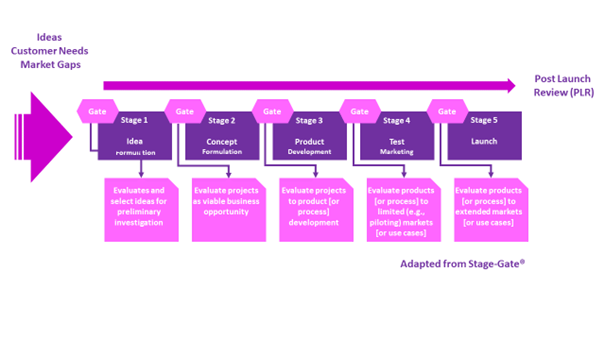
Stage-Gate® model – wherever adapted to specific needs with simple or advanced implementations – has been adopted across various typology of industries and companies impacting processes, culture and performance of numerous organisations (Cooper R., 2005; Stage-Gate International & AIM Institute, 2022). The model structured content has been acting as a change vehicle for how people think and work together.
When critically considering how Stage-Gate® model impacts processes and performance, it is worth analysing the reflections shared by those organizations who implemented the model itself. Reoccurring achievement themes appear to be (Stage-Gate International, 2023):
- Structuring and filling the gaps in global product innovation system with Stage-Gate architecture bringing highly effective governance model, decision making and prioritization processes as for example at Abbott Nutrition, Starbucks, Coca-Cola, CSM Bakery, KaVo Kerr Group, Boral and Almatis.
- Maintaining the right balance between exploitation and exploration as for example at Abbott Nutrition, GOJO, IPEX and National Oilwell Varco.
- Cross-functional and collaborative product development as for example at Starbucks, Corning and BASF
- To accelerate time-to-market without compromising quality as for example at Corning, CSM Bakery and KaVo Kerr Group.
Procter & Gamble (P&G) has been implementing and using Stage-Gate® model successfully for decades now to develop new products and manage their innovation portfolio. P&G’s idea to launch methodology SIMPL – Successful Initiative Management and Product Launch, based on the Stage-Gate® model – has been helping P&G to manage efficiently its new products development portfolio by allocating resources and effort to the right projects (Cooper R. & Mills M.S., 2005).
In adapting the Stage-Gate® model, organizations have been introducing various versions of the model (with reduced or lightweight stages) to increase its scalability and sustain different type of projects at the best. For example, the Kellogg Company’s K-Way innovation process distinguishes new products, small projects, and technology developments. Or 3M that implements five versions, with localization scenarios added on top the similar distinction done by Kellogg. Hewlett-Packard goes for 3 version too, differentiating start-up developments, agile model for growth sectors and traditional phase-review system. Dissimilarly, P&G maintains a single version of its SIMPL process to avoid any proliferation and confusion on how to implement new products (Cooper R., 2014).
That said, not all the implementation of the Stage-Gate® model have been complete or impactful (Adams M. & Boike D., 2004). One out of two Stage-Gate® model implementation reason for failure is due to the lack of effective understanding of the model itself (Stage-Gate International & AIM Institute, 2022). Having dedicated Process Manager roles and enabling all key stakeholders with Stage-Gate® model learning has been an important lesson learned at Almatis to successfully adopt the model (Stage-Gate International, 2023).
One point of attention is to differentiate research and development effort into: New Technology Development, New Product Development and New Process Development. Those three categories fulfil three distinct needs (acquire new knowledge, increase revenue and decrease costs respectively) determining the right context and objective of the model early stages (Stage-Gate International & AIM Institute, 2022).
Given the complexity of new product development portfolio management, at least in large organizations, companies should consider implementing tools and automation to streamline the process and overcome cumbersome manual or low technology management practices (Stage-Gate International & AIM Institute, 2022; Sopheon, 2023).
By processing criticisms (Sopheon, 2018; Planisware, 2019) and streamlining real world experiences lessons learned, the Stage-Gate® model has been changing and evolving over the last forty years to become more Adaptable, able to deliver value faster (Accelerated or Automated) and Agile in its definition – known as the triple “A” (Cooper R., 2014).
For instance, with the NexGen Stage-Gate system and the addition of the spiral development, the model changed to balance fact-based product definition before development, with the need of correcting the product’s design accordingly to feedback and new information (Cooper R., 2006). The spiral approach, based on incremental and iterative principles introduced in the stages and gates, promotes experimentation by encouraging project teams to fail often, fast, and cheaply.
To be more Open Innovation friendly the NexGen Stage-Gate® gates deliverables might include “letters of intent” and “memoranda of understanding” from potential partners and risk-opportunities evaluation criteria for engaging potential partners.
In the updated version of the model the emphasis is now more on results instead of documentation where the iterations help to improve and adapt the obtained results (Cooper R., 2014). The stress on value is emphasized in the Post Launch Review (PLR) where the results achieved are evaluated against the ones estimated in the gates so to reflect potential lessons learned (Cooper R., 2014; Cooper R., 2005).
Embracing the Agile movement (Agile Manifesto, 2001), Cooper introduced the Agile–Stage-Gate as a model to handle performances and processes in high uncertainty and need for experimentation contexts. The aim is to address the Voice of Customer by easily iterate incremental product versions (protocepts) and smoothly learn from the customer’s involvement feedback (Cooper R. & Sommer A. F., 2016).
A potential area of additional improvement for the Stage-Gate® could be represented by start-ups. Start-ups are characterized by a high failure rate relate to inaccurate analysis of the market, consumer needs, incomplete or unintuitive products deriving by poor incubation process. Further tailoring the Stage Gate model may contribute to drastically reduce start-ups problems (Kupczyk T. & Debita G. & Rupa P., 2021).
As stated above the Stage-Gate® model has been evolving in the last forty years reaching its 4th generation stage and looking at opportunity to define the 5th generation outlook (Cooper R., 2022). The intent has been always to embrace new trend and to overcome limitations faced in changing markets circumstances.
Studies to define alternatives to the Stage-Gate® model, or at least to identify context where one model provides more effective outcomes, are designed to support business in managing the high degree of uncertainty of product innovation (Nakata C., 2020). Companies could be in a dilemma where to embrace new models or to adopt the evolutions of the Stage-Gate®. By analysing the data of New Product Development best practices survey sponsored by the PMDA Foundation (PDMA, 2021) evinced that best performing companies are characterized by implementing a variety of NPD practices (Knudsen M. P. & von Zedtwitz M. & Griffin A. & Barczak G., 2023). This outcome makes the diversity principle the real effective best practice companies should adopt in their NPD strategy.
List of References
Adams M. & Boike D. (2004), “ PDMA foundation CPAS study reveals new trends “, Visions, XXVIII: 3, July 2004,pp. 26-29;.
Agile Manifesto (2001) History: The Agile Manifesto Available at: http://agilemanifesto.org/history.html [Accessed: 26/02/2023].
Cooper R. (1988), “The new product process: A decision guide for management”, Journal of Marketing Management, Volume 3, 1988 p 238-255. Available at: http://dx.doi.org/10.1080/0267257X.1988.9964044 [Accessed: 26/02/2023].
Cooper R. (2005), Winning at New Products: Pathways to Profitable Innovation. [pdf] Available at: http://www.five-is.com/wp-content/uploads/2013/12/Cooper_2005_Pathways_to_Profitable_Innovation.pdf [Accessed: 26/02/2023].
Cooper R. & Mills M.S. (2005), Succeeding at New Product Development the P&G Way: A key element is using the “Innovation Diamond”. [pdf] Available at: https://pdf4pro.com/cdn/at-development-the-p-amp-g-way-stage-gate-23a003.pdf [Accessed: 26/02/2023].
Cooper R. & Sommer A. F. (2016), ” The Agile–Stage-Gate Hybrid Model: A Promising New Approach and a New Research Opportunity”, Journal of Product Innovation Management. Available at: http://dx.doi.org/10.1111/jpim.12314 [Accessed: 26/02/2023].
Cooper R. (2006) “The seven principles of the latest Stage-Gate® method add up to a streamlined, new-product idea-to-launch process.” Stage-gate Inc.
Cooper R. (2014), “Invited Article: What’s Next?: After Stage-Gate.”, Research-Technology Management. Available at: http://dx.doi.org/10.5437/08956308X5606963 [Accessed: 26/02/2023].
Cooper R. (2022), ” The 5-th Generation Stage-Gate Idea-to-Launch Process,”, IEEE Engineering Management Review, vol. 50, no. 4, pp. 43-55. Available at: https://ieeexplore.ieee.org/abstract/document/9966814 [Accessed: 26/02/2023].
Knudsen M. P. & von Zedtwitz M. & Griffin A. & Barczak G. (2023) “Best Practices in New Product Development and Innovation: Results from PDMA’s 2021 Global Survey.” Journal of Product Innovation Management 1– 19. Available at: https://doi.org/10.1111/jpim.12663 [Accessed: 26/02/2023].
Kupczyk T. & Debita G. & Rupa P., (2021), “Leadership and Effectiveness of Incubation of Start-Ups: Research Scheme for Next Generation Stage Gate.”, European Research Studies Journal · November 2021. Available at: http://dx.doi.org/10.35808/ersj/2628 [Accessed: 26/02/2023].
Nakata C., (2020), ” Design thinking for innovation: Considering distinctions, fit, and use in firms”, Business Horizons, Volume 63, Issue 6. Available at: https://doi.org/10.1016/j.bushor.2020.07.008 [Accessed: 26/02/2023].
PDMA (2021) PDMA Announces their 2021 Product Development Global Best Practices Survey Results Available at: https://www.pdma.org/news/565745/PDMA-Announces-their-2021-Product-Development-Global-Best-Practices-Survey-Results.htm [Accessed: 26/02/2023].
Planisware (2019) Stage-Gate: What do the critics say? Available at: https://planisware.com/resources/content-hub/stage-gate-what-do-critics-say [Accessed: 26/02/2023].
Sopheon (2018) Stage-Gate – The Origin, Status Quo and Future Available at: https://www.sopheon.com/blog/stage-gate-the-origin-status-quo-and-its-future [Accessed: 26/02/2023].
Sopheon (2023) Accolade Available at: https://www.sopheon.com/products/accolade [Accessed: 26/02/2023].
Stage-Gate International (2023) Client Interviews Available at: https://www.stage-gate.com/insights/?_sft_category=client-interview [Accessed: 26/02/2023].
Stage-Gate International & AIM Institute (2022) 9 Actions to super-charge your Stage-Gate® growth machine [pdf] Available at: https://www.stage-gate.com/report/supercharge-ebook/ [Accessed: 26/02/2023].
 Unfinished Products
Leave a comment