
To be successful unfinished products must create (or be part of) an ecosystem where participants interacts and exchange value. The economy that regulates this value exchange is the platform economy.
Understanding the principles of the platform economy is paramount to develop a valid strategy in designing and implementing unfinished products.
The notions and concepts covered in this article derive from the study and personal analysis of the book “Platform Revolution” by Geoffrey G. Parker, Marshall W. Van Alstyne, and Sangeet Paul Choudary[1]. In spelling out the principles of the platform economy, it becomes clear the importance of APIs and how APIs represent the backbone of the unfinished product ecosystems.
Traditional business models are based on supply economies of scale. In this economic model, organizations focus their capabilities in optimizing the production process to reduce costs and to access new markets. In this sense Digitization is a new boost for supply economies of scale as, thanks to data, automation, intelligence and insight, organizations can further optimize their operation backbone and increase the scalability of their business model.
The Platform Economy is based on the concept of demand economies of scale introduced by Hal Varian (chief economist at Google), and Carl Shapiro (business professor). Demand-side economies of scale (sometimes referred as “network externalities” or “network effects” since their relevance in network industries) are formally defined when: “a good exhibits network effects if the demand for the good depends on how many other people purchase it”[2].
Digital capabilities (social networks; ability to drive insight and aggregate demand information; and indeed APIs) create the opportunities to exponentially enlarging the networks reach and making the networks themselves more valuable to their users.
APIs emerge as the indispensable enabler to drive and sustain the network effect. Think of how Facebook took over MySpace at the end of the 2000s. During the 2007, Facebook launched its APIs and opened the platform to developers. Doing so Facebook enabled the ecosystem in creating composable products based on its platform. As highlighted in the graph below the launch of the APIs is the tip point when the daily reach (number of people that accessed the platform i a given day) of Facebook exponentially grew to overtake MySpace – MySpace was the lead social network at that time and did not open the platform with APIs capabilities. This strategically miss together with the lack of platform quality and governance, defined the end of MySpace.[3]

Platform economy are business model where API plays an important role to achieve the network effect. Platform economy should not be confused with Platform API. Organizations implement Platform API when they need to move beyond implementing APIs for their product [or services] as simple set of endpoints.
With API Platform companies organizes their capabilities around methodologies and best practices to design, maintain and evolve their APIs portfolio. API Platform main technical requirements are: a combination of private, partner, and public APIs; a mixture of API styles; event notification for reacting to change; message streaming to act as a backbone for data [4].
API Platform on its own is not enough to establish a Platform Economy. API Platform scenarios accelerates use cases as: reduce cost to sale; ease to update products description; recommendations; up sell & cross sell scenarios. API Platform on their own do not create “new revenue” opportunities. In the Unfinished Product Strategy Compass, API platform matches the Centralized Integration – API Gateway space.
APIs not only are indispensable to flourish platform economy. APIs themselves could become a vehicle of new revenue for the unfinished products.
An immediate sample on how APIs create new revenue streams is represented by monetizing the usage of the APIs themselves. Companies implementing unfinished products and exposing APIs in the ecosystem can charge the APIs consumer (e.g. developers) on an output-based (e.g. the Twilio “pay-as-you-go” pricing [5]) model, or an outcome-based (e.g. the Expedia “revenue-sharing” or partnership[6]) model.
That said organizations obtain more value from APIs in achieving product and data diversity. Data collected by the unfinished product augment the ability to chase higher degrees of innovation and micro-segmentation[7]. Think how, in Open Banking, traditional financial institutions are extending their business model to address life-needs (housing, transport, health) of their customers – e.g. Bud[8] and HSBC created an ecosystem to provide the intelligence and new customer features[9].
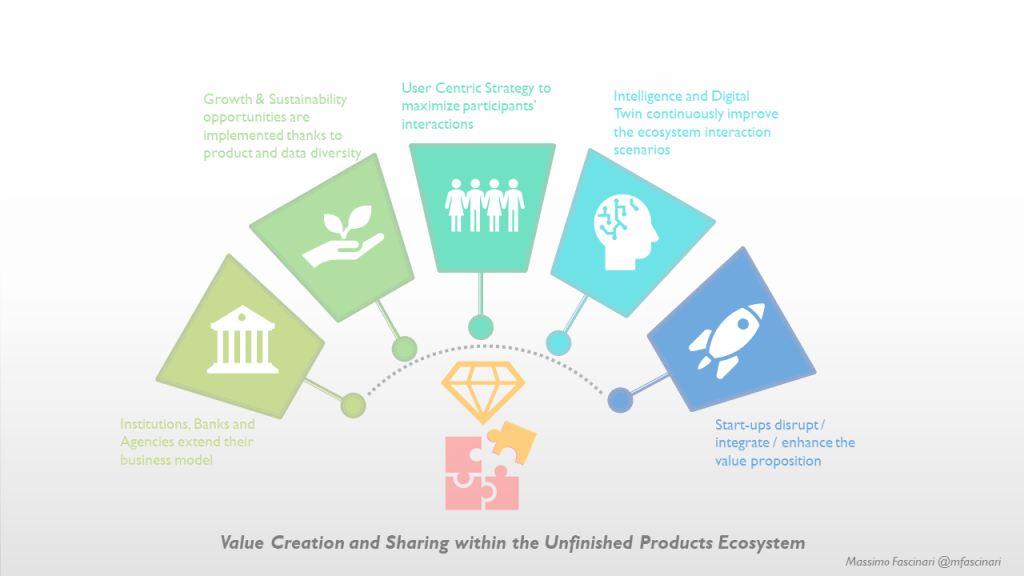
The following info-graphics shows how different stakeholders participate to the unfinished product ecosystem creating and exchanging value. APIs – the connectors – enable the scalability of the platform and the network effect. Growth and sustainability principles are guaranteed by the openness toward both established institutions and new entering start-ups. The value is served and consumed in line with the consumer-centric strategy. Intelligence and predictions are implemented to continuously optimize the interactions between the participants of the ecosystem.
[1] Platform Revolution: How Networked Markets Are Transforming the Economy – and How to Make Them Work for You – https://www.amazon.com/Platform-Revolution-Networked-Markets-Transforming/dp/0393249131
[2] The Economics of Information Technology: An Introduction (Raffaele Mattioli Lectures) – https://www.amazon.com/Economics-Information-Technology-Introduction-Raffaele-ebook/dp/B00E3URHD6
[3] The Rise and Inglorious Fall of Myspace – https://www.bloomberg.com/news/articles/2011-06-22/the-rise-and-inglorious-fall-of-myspace
[4] APIs + Microservices. The ultimate guide to creating an enterprise API platform https://www.techgazzete.com/apismicroservicestheultimateguideto
[5] Twilio, contact center to the cloud API integration – Pricing – https://www.twilio.com/pricing
[6] The Expedia’s Partner API website – https://expediaconnectivity.com/developer
[7] In marketing, a microsegment is a more advanced form of market segmentation that groups a number of customers of the business into specific segments based on various factors including behavioral predictions. Once identified, microsegments can become the focus of personalized direct micromarketing campaigns, each campaign is meant to target and appeal to the specified tastes, needs, wants, and desires of the small groups and individuals that make up the microsegment.[1] The goal of microsegments is to determine, which marketing actions will have the most impact on each set of customers. – https://en.wikipedia.org/wiki/Microsegment
[8] Intelligent Open Banking – Bud FinTech – https://www.thisisbud.com/
[9] HSBC inks global deal with Open Banking outfit Bud – https://www.finextra.com/newsarticle/34933/hsbc-inks-global-deal-with-open-banking-outfit-bud

 Unfinished Products
Leave a reply to Unchaining value – Unfinished Products Cancel reply