In authoring “Digital Twin in distributed scenarios” technical paper[1], we researched and selected a series of published papers and academic works. The methodology used for identifying, screening, and including the papers and academic works has been inspired by the Preferred Reporting Items for Systematic Reviews and Meta-Analyses (PRISMA)[2].
More than one-hundred-fifty papers and articles published from January to May 2021, and available on Google Scholar[3] has been reviewed. The papers and academic works have been retrieved performing google scholar searches based on the keyword as: “edge” “digital twin” “mobility” “security” “experience” as well as “mesh” “digital twin” “edge” “safety” “mobility” “experience”. Each of those papers and academic works have been inserted in our studies database[4].
For each of the entry in the studies database a critical reading of the abstract has been performed aiming to classify the priority (the highest priority is priority 1 and the lowest one is priority 5) of the article versus the scope of our paper.
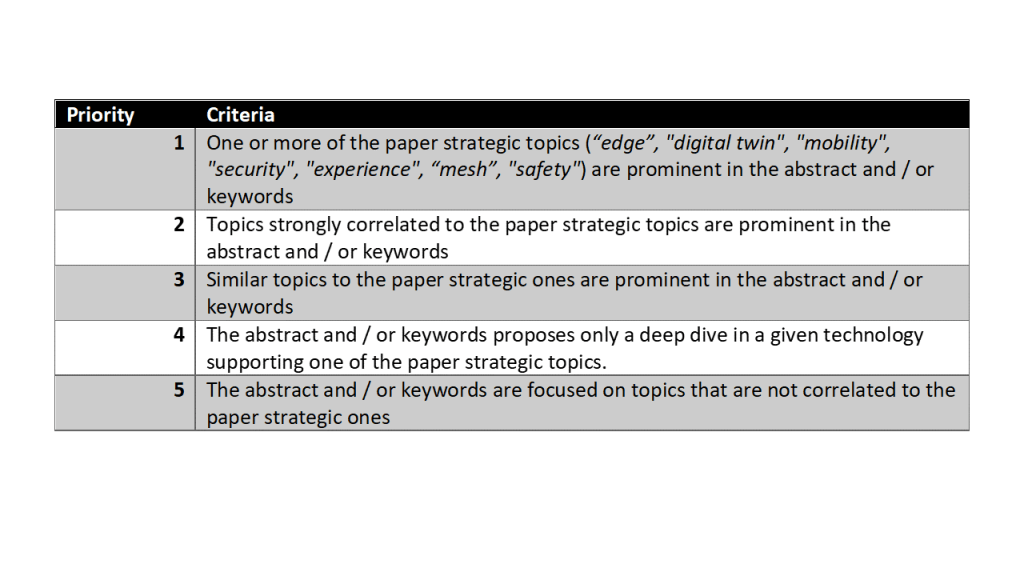
Eighteen entries in the studies database were classified as priority one. The related papers and academic works were studied aiming to effectively review them in line with our paper scope. For each of the eighteen papers and academic works we assigned a “scoring” to document our interpretation of the relevance of the document toward the scope of our paper. The score (an integer value between 0 and 5 the coverage – with 5 being the best match) is aiming to weight the given read paper or academic work against our paper’s strategic topics (“edge” & “mesh”, “digital twin”, “mobility”, “security” & “ Safety”, “Experience”, and “SDG”). We ended up assigning the overall relevance score to the eighteen entries in the studies databased classified as priority one. Finally, for each of the eighteen entries in the studies database, we provided a qualitative flag to distinguish the ones that we interpreted as most valuable in the context of our paper’s scope.
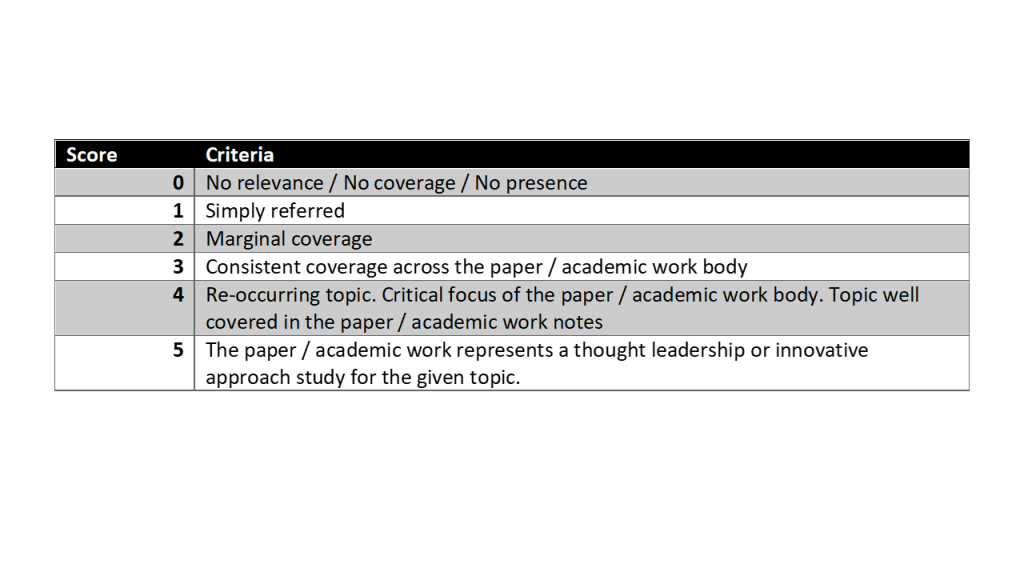
The overall score of the eighteen entries in the studies database is based on the arithmetical weighted sum of the various topics score. “Edge” & “mesh”, “digital twin”, and “SDG” are weighted 5, “mobility”, and “experience” are weighted 3 and finally “security” & “ safety” is weighted 2.

To articulate the answer to our first “The state-of-the-art of Digital Twin within Distributed Architecture technology” question we analyzed the content of the given selected papers or academic work by:
- Identifying the problem statement of the given selected papers or academic work
- How the problem relates to “Continuous Intelligence to support continuous decisions” and “Distributed Architecture” principles. So that we can rearticulate the problem statement from the Distributed Digital Twin prospect.
- How the given selected papers or academic work addresses the problem statement
- The tradeoff the given selected papers or academic work implements to balance the “Continuous Intelligence to support continuous decisions” and “Distributed Architecture” principles
- The role of the digital twin in the given selected papers or academic work outcome
- What we could extrapolate and learn from given selected papers or academic work toward the definition and optimization of Distributed Digital Twin as well as Unfinished Products
Finally, to articulate the answer to our second “How constrains as mobility, security & safety, and experience affects continuous intelligence to support continuous decisions scenarios and the solutions adopted” question we analyzed the content of the given selected papers or academic work by:
- Articulate the given selected papers or academic work problem statement around the mobility, security & safety, and experience requirements
- How the solution proposed by the given selected papers or academic work relates to “Continuous Intelligence to support continuous decisions” principle
- The role of the digital twin as well as the link between mobility and/or security & safety and/or experience and the “Continuous Intelligence to support continuous decisions” principle the given selected papers or academic work’s solution proposes.
Notes
[1] “Digital Twin in distributed scenarios” technical paper. https://www.getrevue.co/profile/mfascinari/archive/603612
[2] PRISMA is an evidence-based minimum set of items for reporting in systematic reviews and meta-analyses. PRISMA primarily focuses on the reporting of reviews evaluating the effects of interventions, but can also be used as a basis for reporting systematic reviews with objectives other than evaluating interventions (e.g. evaluating aetiology, prevalence, diagnosis or prognosis). http://www.prisma-statement.org/
[3] Google Scholar https://scholar.google.com/
[4] “Digital Twin in distributed scenarios” technical paper reviewed research database. https://unfinished-products.com/wp-content/uploads/2022/01/research-edge-digitaltwin-security-mobility-experience-data.xlsx
 Unfinished Products
Leave a comment