
Generative AI as innovation opportunity for Strategic Technology Management services
ChatGPT the Generative Artificial Intelligence chatbot launched recently by OpenAI, a San Francisco based start-up, has becoming in few months a mediatic, social, commercial and innovation phenomenon. ChatGPT is now the most ever fast-growing consumer application .
With early indicators of Generative AI ability to affect various aspect of human life as health, education, safety, food security and the labour market, various studies have been performed to understand the extend of benefits and to anticipate risks and misuse of the technology.
Starting from those broad considerations, this report reflects on what influence and changes Generative AI could have on the Strategic Technology Management discipline.
The reports analyses how Generative AI could extract and capture value in Strategic Technology Management practices and what timeline could be predicted for Generative AI in replacing technology managers’ profession. Before this – at least for now fictional – scenario could be achieved, the report articulates the skills technology managers should develop and how they could use Generative AI for performing Strategic Technology Management activities. In addition, the report stresses the need for technology managers to govern Generative AI concerns like ethical responsibility, transparency, explainability, confidentiality and decision-making accountability.
ChatGPT works with a simple textual interactive interface responding to users’ questions developing facsimile natural conversations. Based on the language model GPT4, ChatGPT is optimized by using Reinforcement Learning with Human Feedback technologies. Generative AI algorithms combine generative modelling and deep learning technologies, to create synthetic content artifacts as the result of existing content (training set) analysis. Generative AI analysis identifies patterns in existing content and eventually delivers realistic artifacts reproductions.
However, trained also on polluted content available on Internet, ChatGPT risks to provide controversial, untruth and offensive answers or to raise plagiarism and intellectual property concern .
for the complete view of the report please contact me
In the years, organizations have been structuring their Strategic Technology Management practices establishing methodologies and performing Strategic Technology Management activities performed to address their needs. Technology managers work together with business strategist defining technology evolution and enablers sustaining the strategic business objectives. Quantitative and qualitative data are collected to govern operations and transformation efforts, to ensure technology is providing the desired value. By paraphrasing studies on the use of AI in board decisions (Accenture, 2016) the article inferences the following evolution of Generative AI enabled Strategic Technology Management practices.
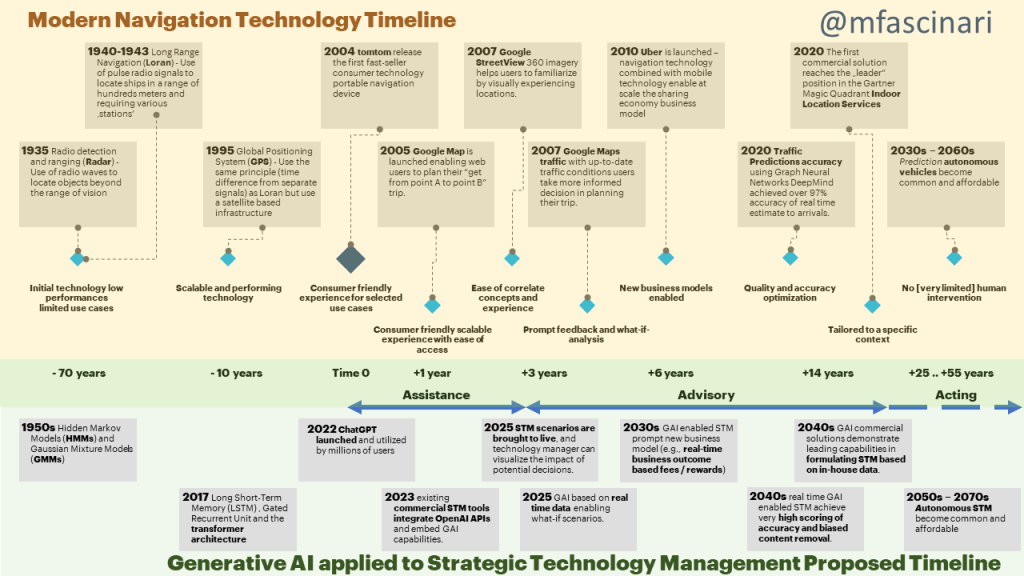
In “Assistance”, the first horizon, technology managers make decisions by using Generative AI enabled Strategic Technology Management tools who increase technology managers’ productivity.
In “Advisory”, the second horizon, Generative AI have a more active role, but technology managers still own the decision power, controlling the integrity of the decision-making process. It is here that Generative AI itself becomes one of the organization’s sources of innovation.
In the last horizon “Acting” Generative AI is in control. Decision-making could be shared (amplified intelligence) with the machines or delegated to them (autonomous intelligence).
A stage of autopoietic intelligence – with the machine able to expand its intelligence from a certain domain to another – is for now relegated to science fiction only (Hilb M., 2020).
The article proposes a framework to profile the possible timeline of the three horizons. The framework is based on analysing the timeline of navigation technology and how the introduction of digital and AI capabilities has been affecting the transportation industry.
For the complete view of the report please contact me
Conclusion
Reflecting on:
- pace of innovation
- Generative AI proximity to achieve satisfaction for undemanding users
- adoption of Lean Start-up methodology
- Generative AI ability to improve performances of complex content creation process
- the Strategic Technology Management discipline intrinsic innovation attitude,
this article concludes Generative AI is very likely to change how Strategic Technology Management is performed, and to affect technology managers’ job.
By rendering innovation patterns happened in the navigation technology, the article predicts that by 2025, early adopter organizations are likely to experiment Generative AI in assisting Strategic Technology Management activities performance and Strategic Technology Management tools use. By the next decade, organizations will start using Generative AI as advisor for their Strategic Technology Management needs. Eventually, in the second half of the century, Generative AI might have reached a level of maturity enabling organizations to run their Strategic Technology Management practices with limited human intervention.
In between technology managers need to evolve their critical-thinking skills and the ability to work symbiotically with machines. While institutions, academics and industry leads will need to address and govern all the risks Generative AI poses as ethical responsibility, transparency, explainability, confidentiality and decision-making accountability.


Leave a comment